In today’s fast-paced digital landscape, companies are constantly seeking ways to innovate quickly and efficiently. Enter the Google Design Sprint, a powerful methodology that has revolutionized the way teams approach problem-solving and product development.
What is a Google Design Sprint?
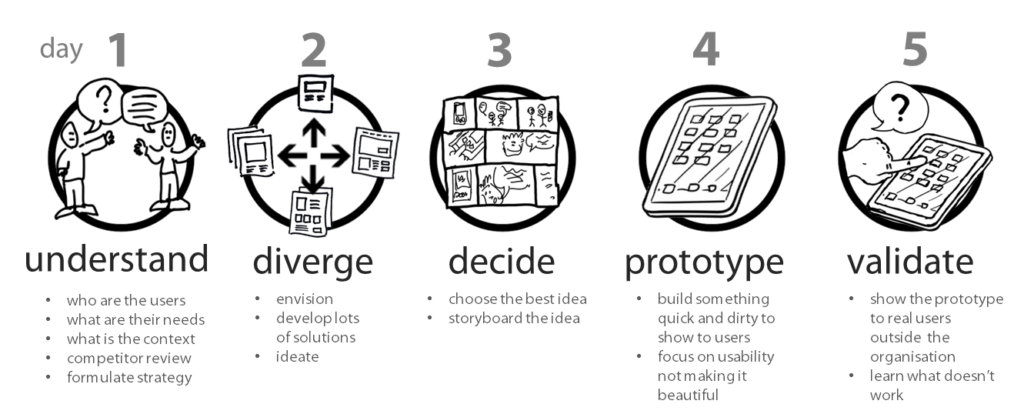
A Google Design Sprint is a five-day process developed by Google Ventures to help businesses rapidly solve critical challenges through design, prototyping, and testing ideas with customers112. This time-constrained approach combines elements of business strategy, innovation, behavior science, and design thinking into a battle-tested process that any team can use12.
The Six Phases of a Google Design Sprint
Google’s Design Sprint methodology follows six distinct phases11:
- Understand: Teams unpack the problem and create a shared knowledge base.
- Define: Participants align on principles and scope out the ideal user journey.
- Sketch: This phase focuses on generating a broad range of ideas within a time-boxed format.
- Decide: The team votes and decides on the ideas to pursue further.
- Prototype: A tangible representation of the chosen ideas is created.
- Validate: The prototype is put in front of users to gather feedback and insights.
Benefits of Running a Google Design Sprint
Implementing a Design Sprint can offer numerous advantages to your organization:
- Rapid Innovation: Compress months of work into a single week, fast-forwarding into the future to see your finished product and customer reactions12.
- Alignment: Get all stakeholders on the same page regarding desired outcomes and solution behavior7.
- Customer-Centric Approach: Gain deep insights into user needs and behaviors through early testing7.
- Risk Mitigation: Validate assumptions and test ideas in a low-cost, low-risk environment before committing significant resources7.
- Team Building: The immersive and collaborative nature of the sprint fosters unity and passion within cross-functional teams7.
Who Should Participate?
A Google Design Sprint typically involves a small, cross-functional team of 4-7 people2. Key roles include:
- Facilitator
- Designer
- Decision-maker (often a CEO in startups)
- Product manager
- Engineer
- Representatives from core business departments
Real-World Success Stories
Many companies have leveraged the Google Design Sprint methodology to drive innovation and solve complex problems. For instance, Tyson worked with Table XI to develop and test the initial idea for Yappah, a snack designed to reduce food waste, using a five-day Google Design Sprint3.
Conclusion
The Google Design Sprint offers a structured, time-efficient approach to problem-solving and innovation. By embracing this methodology, organizations can rapidly validate ideas, align teams, and create user-centric solutions. As the business landscape continues to evolve, the Design Sprint stands as a powerful tool for companies looking to stay ahead of the curve and deliver exceptional products and services to their customers.Whether you’re a startup looking to launch a new product or an established enterprise seeking to improve existing offerings, the Google Design Sprint provides a framework to turn your ideas into reality – all in just five days.